It seems that I have attained the status of everyone’s “Resident BYU Fan.” As such, with the events that have transpired surrounding the BYU Basketball team this past week, many people have asked me what I think of it all. So here you go:
I haven't felt this way since September 19, 2009. Two weeks earlier the BYU football team had pulled off what most thought impossible: beating a ranked Oklahoma football team, who had an eventual Heisman trophy winner and first round NFL draft pick under center, in its own backyard and on a national stage. The next week they cruised to a victory over a quality Tulane team on the road, again on national TV. After both games I stood on the tarmac of the Provo airport to welcome my team home after their stellar performance with hundreds of fellow fans. I was excited for the first home game of the season. BYU was playing against Florida State, there was a nationwide buzz about the teams’ chances, and sports analysts from coast to coast were talking about a bunch of white Mormons who were making waves in college football. Then my Cougars laid an egg. They turned the ball over, produced little offense, and couldn't get a third down stop to save their lives. I walked back to my apartment in silence. It wasn't the loss that bothered me, it was how poorly we played.
Now fast forward to this week. I was just arriving at my apartment Tuesday afternoon. I glanced at my phone as I often do to check my "Tweets" and saw one from Greg Wrubell briefly stating that Brandon Davies had been suspended for the rest of the season due to an honor code violation. The tweets weren't only from Greg, but from reporters at other local papers, and basketball analysts at ESPN and CBS Sports. I ran up the stairs and into my room to read the reports online. I felt sick for a lot of reasons, but mainly because here was a nineteen year old kid who was having his dirty laundry aired for the world to see. I can only imagine how embarrassed, ashamed, and foolish he must feel. Aside from the spiritual ramifications of his decision, his education and basketball career are now in jeopardy. He let his teammates, his coaches, his school, and thousands of fans down. There was no doubt in my mind that if anyone in the world understood the gravity of his decisions, it was Brandon Davies.
This provides one more venue for the age old honor code debate. Is it fair? Is it too harsh? Is it realistic? Is it really what Jesus would do? One thing that most debaters fail to realize is that the Honor Code is not a list of commandments, it is an agreement that you make with the university. You promise to abide by certain rules and the university agrees to provide you with a world class education in a spiritually uplifting environment for a very reasonable price. If you don't hold up your end of the agreement you don't get those benefits. Everyone knows what they are agreeing to when they apply. The honor code office isn't in the business of repentance; they are there to enforce a sort of contract that each student has made with the university. Repentance will happen between Brandon and the Lord, possibly with the help of his bishop. The fact that he violated a commitment that he made will be handled by the honor code office.
Last Saturday I once again found myself standing in the rain and snow on the tarmac of the Provo airport. I was welcoming home a team that had just beaten a top ten team on a national stage. There was once again a national buzz about a bunch of white Mormons in Provo contending for a possible 1-seed in the NCAA basketball tournament. The small group of fans was enthusiastic to congratulate their team for pulling off what most people thought impossible, a regular season sweep of SDSU.
The game on Wednesday was no different from any of the other recent conference games except for one thing. Students camped out for days in a line that almost surrounded the Marriott Center, the arena was packed to capacity, and the eyes of the nation were watching, but there was a tangible sense of apprehension. No one knew exactly how Davies’ shoes would be filled. I reassured my friends that we had a bench full of players that were eager to contribute and that we have an amazing coach who was very capable of making the necessary adjustments, and we had the Jimmer!
At halftime I could believe what I was seeing. I texted my dad saying that there was no way we could continue to shoot as poorly as we did. The offense was out of sync, players were bobbling the ball, and New Mexico couldn’t miss. The second half didn’t turn out to be much better. After the game I stood there in silence. I was stunned. It wasn’t the loss that bothered me, it was how poorly we played.
Now the only thing left to be seen is how the team will react. A week ago BYU was thought of by many as a one man team, the BYU Jimmers. Now those same people are saying that we can’t win because we lost our third leading scorer. The lack of Davies’ presence will surely be noticed, but I have full faith that Coach Rose and the rest of the team still have what it takes to win, and they will find ways to win just like they have all season.
BYU has its final home game of the season tomorrow against Wyoming, and do you know where you’ll find me at 6am? I’ll be in a sleeping bag on the sidewalk outside the Marriott Center counting the hours until tipoff. Go Cougars!
Friday, March 04, 2011


Friday, March 26, 2010
My gas bill and how it affects you.
I got my utility bill in the mail today. It’s not the most I’ve ever paid for a month of utilities (I think last month might be the record) but it’s still higher than what I’ve paid on average over the last few years that I’ve lived in Provo.
You might be wondering why I’m writing about something as boring as my utility bill.
But recent events have me rethinking a lot of things. You see in the apartment complex where I live every resident gets a utility bill. I like this because I don’t have to put a utility in my name and then hound my roommates for money each month, and then be left footing the bill if they decide not to pay as is the case with many student apartments. It’s one less thing that I have to worry about. (And for the record, I don’t think any of my roommates past or present would ever leave me hanging with a bill, but it’s still easier this way.)
If any of you are like me you’ve probably resolved, after seeing the amount of your bill, to use less, be it turning off the lights, turning down the thermostat, or taking shorter showers. Not only will these things save you money, but reducing the amount of energy that we use is a good thing. For six months I’ve been living in this apartment, and trying to save money I have been very vigilant to turn off the lights and to keep the thermostat at an appropriate temperature. I thought I was doing the responsible thing by saving me and my roommates money, but I never really saw my bill go down. In fact it seemed to go up, even in December when the apartment was practically empty for half of the month. It’s never been something I can’t afford. It’s not unreasonably high plus I’ve worked hard and saved money to pay for expenses like this while I’m going to school.
I found out about a month ago that the gas portion of our utility bill (the most expensive part) isn’t billed to us based on how much we use, but the gas bill for the entire complex is split evenly between the tenants. So let’s suppose for a minute that my energy saving efforts eliminate about $5 worth of gas usage in a month. There are over 1000 residents in my complex, and again supposing that their utilities usages remain the same, that $5 that my efforts saved divided among those 1000 tenants ends up being $0.005 or one half of one cent. Among my neighbors there has to be others like me who are trying to use less, but my experience tells me that there are a lot more people in student housing that don’t think twice about what utilities cost them each month. Either because it doesn’t occur to them that having a window open and the furnace on is like throwing money out the window or because mom and dad take care of the bills.
So I started thinking, is it really worth it for me to focus so much of my attention on using less energy just to save myself half of a penny when so many others don’t seem to care. Being a responsible user really isn’t benefitting me so why should I even try. I could focus my attention on much more (or less) important things and at the end of the month the amount that I write a check for will depend on how much everyone else used. But over time that attitude will result in higher bills for everybody. Each cubic foot of gas costs money and whether each person pays for exactly what they use or if your bill is subsidized by the prudence of others that money comes out of someone’s pocket.
It would be nice if everyone decided to conserve energy because it was good for the environment, but in reality people are and only when their utility bills are ridiculously large with they start to consider how their own choices might be effecting how much money they have left over at the end of the month.
There has been a lot of talk about the new healthcare bill that was passed earlier this week. It has been called the most significant piece of legislation passed in decades. I’m not going to claim expert knowledge of the bill, but from what I understand it will force insurance companies to cover anyone who applies regardless of pre-existing conditions, and puts a limit on how much they can charge. And then the government (read tax payers) will subsidize the cost of insurance for those who “can’t afford it.” Everyone will be required to participate or they will be fined. Sounds like a good plan right? Everyone gets insurance and the government will make sure that it is cheap. Let’s think about this for a minute.
The way I understood insurance companies was pretty simple: You paid so much money each month based on how big of a financial risk you were to the company. A healthy person who would require minimal medical attention would have lower monthly premiums and lower deductibles because in the end they would require the insurance company to pay out less money. An person who is unhealthy, either because of their own bad choices or luck of the draw, would require more frequent medical attention would have higher monthly premiums and higher deductibles because in the end the insurance company would end up paying out more for that person. It’s all a calculated risk based on statistics. Either way you get help paying the bills for things that are covered by your insurance plan, and in the case of a catastrophic illness or injury (if you have a decent plan) you’ll get help paying for the enormous medical bills that usually accumulate (hence why it is called insurance). It’s the same for any other type of insurance: if the insurance company thinks that insuring you is risky because you are a bad driver or your house was built on a flood plain, then you are going to pay more for insurance.
There are ways that this can work in your favor. By keeping a clean driving record or taking a defensive driving course some insurance companies will lower your auto insurance premiums. If you take care of your health (i.e. eat right, exercise, don’t smoke, etc.) then when you apply for health insurance you’d most likely be considered a low risk and you’d save money. By being required to pay a relatively small amount out of pocket for each doctor visit that incentive to stay healthy continues. If I take care of my self then at the end of the year I’ll have more money in my pocket.
Under this new bill an insurance company will be forced to cover everyone, including those people who consist on a diet of Cheetos and Bud Light (at least it’s light) and consider running to the refrigerator during a commercial break exercise. I know not everyone is like this; I’m just trying to illustrating a point. Because of these people’s poor lifestyle choices they are usually considered high medical risks because they are more likely to develop illnesses such as heart disease and diabetes among others. But the insurance company won’t be able to charge them according to the risk that they pose; they’ll only be able to charge the federally mandated limit. So how does that affect the rest of us? Everyone else’s rates go up. Since they can’t charge the high risk people more they will make up the difference by charging the rest of us more, even though we’ve been careful to make sure that we are “low risk.” The insurance company is going to have to make up that money somewhere, remember that the bill has to be paid out of someone’s pocket. And what’s the incentive for the insurance company to charge less than the mandated maximum? Remember that we are now legally required to have health insurance.
Now that the cost will be divided equally among everyone the thousands of dollars that I “save” every year by living healthy are divided among millions who might not be as careful. Do you think those savings will show up on my bottom line? Probably not. Why should I work hard to benefit “the system” when there are so many who, whether they are cognizant of it or not, are a drain on the system? Not only will my insurance costs go up, but I will be taxed more to pay for all of the subsidies and tax credits. Remember, the money has to come from somewhere. And if there ends up being less money to pay for things like medical procedures and doctors visits, do you think that those services are going to improve? Do you think that the bright young minds in our country are going to aspire to be doctors when can go to half as much school and make twice as much money? There will be no incentive for innovation in the health industry and then everyone suffers.
There are motivations for me to make good choices: my own health, and the benefit of society, both noble causes. But in my experience there are enough people out there who care little about either. I look at other government assistance programs as evidence. Working for several years at a grocery store I could see that most of the people getting help through food stamps or WIC somehow needed that money to buy “food,” but in that same trip to the grocery store could drop fifty dollars of their own money on cigarettes and beer. (I know that not everyone on assistance programs behave like this, but ask anyone who has worked at a grocery store, it’s a majority.) And whether we like it or not we as humans are motivated by self preservation. There are few people out there who make decisions based solely on how it will benefit society.
You might be wondering how I could be so naïve and heartless. For the record I have been denied coverage because of a preexisting condition, one that is not totally under my control. I can understand where those people are coming from, but we all have different challenges in our lives. I already donate to programs that help provide for people who have fallen on hard times both through taxes and other donations of my own free will and choice. I’m not opposed to helping other people; I’m opposed to a bureaucrat in Washington D.C. telling how and when. I’m not saying that this new plan is socialized medicine, but I do believe that it is a step in that direction.
It all comes down to the fact that I’d rather have less government than more. If people weren’t so burdened with taxes maybe they’d be able to take care of themselves instead of becoming more dependent on the government. Or maybe the government ought to find ways to help people fix their own problems instead of trying to fix it for them. Making everyone dependent on the government does not make us a stronger nation. I believe that our founding fathers were inspired when they created this nation. A nation based on the rights of individuals to carve out their own destiny, not to have everything handed to them.
If you’ve made it this far, I sincerely thank you for your time.
You might be wondering why I’m writing about something as boring as my utility bill.
But recent events have me rethinking a lot of things. You see in the apartment complex where I live every resident gets a utility bill. I like this because I don’t have to put a utility in my name and then hound my roommates for money each month, and then be left footing the bill if they decide not to pay as is the case with many student apartments. It’s one less thing that I have to worry about. (And for the record, I don’t think any of my roommates past or present would ever leave me hanging with a bill, but it’s still easier this way.)
If any of you are like me you’ve probably resolved, after seeing the amount of your bill, to use less, be it turning off the lights, turning down the thermostat, or taking shorter showers. Not only will these things save you money, but reducing the amount of energy that we use is a good thing. For six months I’ve been living in this apartment, and trying to save money I have been very vigilant to turn off the lights and to keep the thermostat at an appropriate temperature. I thought I was doing the responsible thing by saving me and my roommates money, but I never really saw my bill go down. In fact it seemed to go up, even in December when the apartment was practically empty for half of the month. It’s never been something I can’t afford. It’s not unreasonably high plus I’ve worked hard and saved money to pay for expenses like this while I’m going to school.
I found out about a month ago that the gas portion of our utility bill (the most expensive part) isn’t billed to us based on how much we use, but the gas bill for the entire complex is split evenly between the tenants. So let’s suppose for a minute that my energy saving efforts eliminate about $5 worth of gas usage in a month. There are over 1000 residents in my complex, and again supposing that their utilities usages remain the same, that $5 that my efforts saved divided among those 1000 tenants ends up being $0.005 or one half of one cent. Among my neighbors there has to be others like me who are trying to use less, but my experience tells me that there are a lot more people in student housing that don’t think twice about what utilities cost them each month. Either because it doesn’t occur to them that having a window open and the furnace on is like throwing money out the window or because mom and dad take care of the bills.
So I started thinking, is it really worth it for me to focus so much of my attention on using less energy just to save myself half of a penny when so many others don’t seem to care. Being a responsible user really isn’t benefitting me so why should I even try. I could focus my attention on much more (or less) important things and at the end of the month the amount that I write a check for will depend on how much everyone else used. But over time that attitude will result in higher bills for everybody. Each cubic foot of gas costs money and whether each person pays for exactly what they use or if your bill is subsidized by the prudence of others that money comes out of someone’s pocket.
It would be nice if everyone decided to conserve energy because it was good for the environment, but in reality people are and only when their utility bills are ridiculously large with they start to consider how their own choices might be effecting how much money they have left over at the end of the month.
There has been a lot of talk about the new healthcare bill that was passed earlier this week. It has been called the most significant piece of legislation passed in decades. I’m not going to claim expert knowledge of the bill, but from what I understand it will force insurance companies to cover anyone who applies regardless of pre-existing conditions, and puts a limit on how much they can charge. And then the government (read tax payers) will subsidize the cost of insurance for those who “can’t afford it.” Everyone will be required to participate or they will be fined. Sounds like a good plan right? Everyone gets insurance and the government will make sure that it is cheap. Let’s think about this for a minute.
The way I understood insurance companies was pretty simple: You paid so much money each month based on how big of a financial risk you were to the company. A healthy person who would require minimal medical attention would have lower monthly premiums and lower deductibles because in the end they would require the insurance company to pay out less money. An person who is unhealthy, either because of their own bad choices or luck of the draw, would require more frequent medical attention would have higher monthly premiums and higher deductibles because in the end the insurance company would end up paying out more for that person. It’s all a calculated risk based on statistics. Either way you get help paying the bills for things that are covered by your insurance plan, and in the case of a catastrophic illness or injury (if you have a decent plan) you’ll get help paying for the enormous medical bills that usually accumulate (hence why it is called insurance). It’s the same for any other type of insurance: if the insurance company thinks that insuring you is risky because you are a bad driver or your house was built on a flood plain, then you are going to pay more for insurance.
There are ways that this can work in your favor. By keeping a clean driving record or taking a defensive driving course some insurance companies will lower your auto insurance premiums. If you take care of your health (i.e. eat right, exercise, don’t smoke, etc.) then when you apply for health insurance you’d most likely be considered a low risk and you’d save money. By being required to pay a relatively small amount out of pocket for each doctor visit that incentive to stay healthy continues. If I take care of my self then at the end of the year I’ll have more money in my pocket.
Under this new bill an insurance company will be forced to cover everyone, including those people who consist on a diet of Cheetos and Bud Light (at least it’s light) and consider running to the refrigerator during a commercial break exercise. I know not everyone is like this; I’m just trying to illustrating a point. Because of these people’s poor lifestyle choices they are usually considered high medical risks because they are more likely to develop illnesses such as heart disease and diabetes among others. But the insurance company won’t be able to charge them according to the risk that they pose; they’ll only be able to charge the federally mandated limit. So how does that affect the rest of us? Everyone else’s rates go up. Since they can’t charge the high risk people more they will make up the difference by charging the rest of us more, even though we’ve been careful to make sure that we are “low risk.” The insurance company is going to have to make up that money somewhere, remember that the bill has to be paid out of someone’s pocket. And what’s the incentive for the insurance company to charge less than the mandated maximum? Remember that we are now legally required to have health insurance.
Now that the cost will be divided equally among everyone the thousands of dollars that I “save” every year by living healthy are divided among millions who might not be as careful. Do you think those savings will show up on my bottom line? Probably not. Why should I work hard to benefit “the system” when there are so many who, whether they are cognizant of it or not, are a drain on the system? Not only will my insurance costs go up, but I will be taxed more to pay for all of the subsidies and tax credits. Remember, the money has to come from somewhere. And if there ends up being less money to pay for things like medical procedures and doctors visits, do you think that those services are going to improve? Do you think that the bright young minds in our country are going to aspire to be doctors when can go to half as much school and make twice as much money? There will be no incentive for innovation in the health industry and then everyone suffers.
There are motivations for me to make good choices: my own health, and the benefit of society, both noble causes. But in my experience there are enough people out there who care little about either. I look at other government assistance programs as evidence. Working for several years at a grocery store I could see that most of the people getting help through food stamps or WIC somehow needed that money to buy “food,” but in that same trip to the grocery store could drop fifty dollars of their own money on cigarettes and beer. (I know that not everyone on assistance programs behave like this, but ask anyone who has worked at a grocery store, it’s a majority.) And whether we like it or not we as humans are motivated by self preservation. There are few people out there who make decisions based solely on how it will benefit society.
You might be wondering how I could be so naïve and heartless. For the record I have been denied coverage because of a preexisting condition, one that is not totally under my control. I can understand where those people are coming from, but we all have different challenges in our lives. I already donate to programs that help provide for people who have fallen on hard times both through taxes and other donations of my own free will and choice. I’m not opposed to helping other people; I’m opposed to a bureaucrat in Washington D.C. telling how and when. I’m not saying that this new plan is socialized medicine, but I do believe that it is a step in that direction.
It all comes down to the fact that I’d rather have less government than more. If people weren’t so burdened with taxes maybe they’d be able to take care of themselves instead of becoming more dependent on the government. Or maybe the government ought to find ways to help people fix their own problems instead of trying to fix it for them. Making everyone dependent on the government does not make us a stronger nation. I believe that our founding fathers were inspired when they created this nation. A nation based on the rights of individuals to carve out their own destiny, not to have everything handed to them.
If you’ve made it this far, I sincerely thank you for your time.
Friday, February 26, 2010
Correlation or Irony?
I bought two things at the bookstore today: The first thing was a new 200-sheet pad of engineering computation paper. (For my engineering classes I’m required to use this type of paper to submit my homework.) This might not seem significant but I’ve already gone through one 200-sheet pad and the semester is barely half over. In the past I’ve bought 50-sheet pads and it lasted the whole semester and then some. Why is this significant? It’s an indication to me that I’m doing a ton of homework. It’s not uncommon for me to spend 12 or more hours a day on campus attending class and studying. (If it’s a Tuesday or Thursday I never leave the Clyde Building.)
The second thing was a book on dating that I had read about in the Daily Universe. It seemed to have a different approach on the subject compared to other books I’ve skimmed in the past so I decided that it was worth the $12 investment. I’m slightly ashamed to admit that I bought such a book, but not ashamed enough to not share this story through the most public medium on earth.
Now I’m trying to decide if these two purchases are correlated. Am I spending so much time doing homework that my dating life needs help? (Or is a lack of dating life driving me to spend countless hours analyzing indeterminate structures and open channel flow?) The phrase “Correlation does not imply causation!” from Patty, my stats professor will be forever ingrained in my mind, but I wonder. Either way I couldn’t help but see the irony in the situation.
To top it off, with my purchase the bookstore gave me a voucher for a ticket to an upcoming jazz concert on campus. That’s half a date right there. Maybe I should get started on that book, someone else can analyze those structures.
The second thing was a book on dating that I had read about in the Daily Universe. It seemed to have a different approach on the subject compared to other books I’ve skimmed in the past so I decided that it was worth the $12 investment. I’m slightly ashamed to admit that I bought such a book, but not ashamed enough to not share this story through the most public medium on earth.
Now I’m trying to decide if these two purchases are correlated. Am I spending so much time doing homework that my dating life needs help? (Or is a lack of dating life driving me to spend countless hours analyzing indeterminate structures and open channel flow?) The phrase “Correlation does not imply causation!” from Patty, my stats professor will be forever ingrained in my mind, but I wonder. Either way I couldn’t help but see the irony in the situation.
To top it off, with my purchase the bookstore gave me a voucher for a ticket to an upcoming jazz concert on campus. That’s half a date right there. Maybe I should get started on that book, someone else can analyze those structures.
Wednesday, September 09, 2009
Tough as Nails
Several years ago my family and I found ourselves at my grandparents’ house in Manassa Colorado. That year my grandparents were hosting a reception in their back yard in honor of my cousin’s recent wedding. We were setting up a few collapsible canopies to provide shade while the sun was out. One of the drawbacks to these canopies is that if they aren’t staked down properly, the slightest breeze can turn them into supersized tumbleweeds.
As we were getting everything ready the wind kicked up and true to form the canopies started rolling around the backyard. The decision was made to stow the canopies and the reception went on swimmingly without them.
While we were cleaning things up that night someone noticed some white medical tape on my granddad’s hand. When we asked him what happened he explained that when one of the canopies had started rolling across the yard he reached out to stop it and in the scuffle he received a cut on his hand. When we asked to see the extent of the damage my granddad removed the tape and revealed not the small cut that we were expecting to see, but a gaping hole between his middle and ring fingers.
Not wanting to bother anyone with what he considered a minor scratch, my granddad said that he quietly went into the house, poured hydrogen peroxide into his wound, and taped his fingers together. He then continued on and attended the reception and no one suspected a thing.
I would like each of you to put yourself in his situation. Imagine that you are out doing some sort of work, and you look down and see blood oozing out of a gaping hole in your hand. Would you quietly tend to your wound and resume normal activity? Or would you enter into a state of crazed shock and hyperventilate until someone rushed you to the ER? You think my granddad is tough? In the words of Bachman-Turner Overdrive, “You ain’t seen nothin’ yet.”
As we were getting everything ready the wind kicked up and true to form the canopies started rolling around the backyard. The decision was made to stow the canopies and the reception went on swimmingly without them.
While we were cleaning things up that night someone noticed some white medical tape on my granddad’s hand. When we asked him what happened he explained that when one of the canopies had started rolling across the yard he reached out to stop it and in the scuffle he received a cut on his hand. When we asked to see the extent of the damage my granddad removed the tape and revealed not the small cut that we were expecting to see, but a gaping hole between his middle and ring fingers.
Not wanting to bother anyone with what he considered a minor scratch, my granddad said that he quietly went into the house, poured hydrogen peroxide into his wound, and taped his fingers together. He then continued on and attended the reception and no one suspected a thing.
I would like each of you to put yourself in his situation. Imagine that you are out doing some sort of work, and you look down and see blood oozing out of a gaping hole in your hand. Would you quietly tend to your wound and resume normal activity? Or would you enter into a state of crazed shock and hyperventilate until someone rushed you to the ER? You think my granddad is tough? In the words of Bachman-Turner Overdrive, “You ain’t seen nothin’ yet.”
 After a few phone calls we finally got a hold of the local doctor and without hesitation he said that he would meet us at his office. My dad volunteered to drive him there and I opted to tag along. We met Dr. Jackson at the back door of his clinic and he led us into a room where he began prepping for sutures. Since there were no nurses or assistants present my dad took upon himself that role and he performed admirably. Under Dr. Jackson’s instructions my dad gathered materials and supplies for the treatment.
Dr. Jackson began by examining and cleaning the wound. After he confirmed that stitches were indeed necessary local anesthetic was applied with a small syringe. If anyone has been stuck with a needle of any size anywhere in your hand you know how painful it can be, now imagine not only getting shots in your fingers and hand, but inside a deep gash in your hand. My granddad didn’t even flinch.
After letting the anesthetic set in for a few minutes Dr. Jackson began suturing the wound. The cut was severe enough that he had to tie several stitches inside my granddad’s hand. After the doctor had tied two or three of the stitches he suddenly stopped himself and said, “I’m sorry I forgot to ask Cletus, but can you feel that?”
My granddad looked up at him and with his gruff voice simply said “Yeah.”
For whatever reason the anesthetic hadn’t kicked in yet and the doctor had gone to work tying stitches not knowing that my granddad could still feel everything. Meanwhile, my granddad sat there with no complaints, no grimaces on his face, and no squirming in his seat. Not even a calm “Uh doc, I can still feel that.”
The doctor gave him a few more numbing shots and after making sure that his hand was numb proceeded to tie around fifteen stitches total. I always knew that he possessed many great qualities, but from this moment on I knew for a fact that my granddad is tough as nails.

Saturday, September 05, 2009
Scottfunkel's Handy Guide to Picture in Picture
Football season is upon us. One of the great things about Saturdays in the fall is the fact that you can roll out of bed, turn on the TV, and be immersed in the glorious institution that is college football for the rest of the day. The game of football has changed dramatically over the years, and so has the way that we, as fans, follow it. Long gone are the days where families and friends would gather around a radio to listen to an audio only broadcast of the event; now we gather ‘round TVs large and small to witness, in full color (and sometimes better than real life high definition), the game that we love.
I recently moved into an apartment that has a big screen TV. It’s not what you’d call state of the art. The picture is not in high definition, and it does not have surround sound capabilities, but it does have one feature that has revolutionized the way I watch sports: Picture in Picture.
I recently moved into an apartment that has a big screen TV. It’s not what you’d call state of the art. The picture is not in high definition, and it does not have surround sound capabilities, but it does have one feature that has revolutionized the way I watch sports: Picture in Picture.
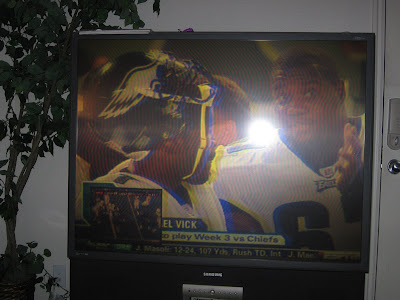
For those of you not familiar with this antiquated television feature, picture in picture allows you to display in one corner of your TV screen a video feed from a channel other that the one you are currently watching. You may be thinking, “Scott, picture in picture is so 1990s. Nobody can watch two channels at once. Why would anyone need that?” Let me explain. Anyone with a basic cable or satellite package will attest to the fact that on any given Saturday in the fall there are at least four channels broadcasting a football game. It is impossible to follow the progress of each and every game, but that won’t stop an avid fan of the game from trying. The advent of the remote control has allowed us to change channels in an extremely efficient manner with out leaving the comfort of our couch. TV commercials are a fact of life, and while some see them as an annoyance, others see them as an opportunity to check in on another game. The problem is that nobody except the producer in the broadcast truck knows exactly how long a commercial will last. And all too often when we try to check in on another game we linger too long and end up missing an important play, injury update, or broadcast note. You can check back every few seconds to see if your game is back on, but if you check back too often it’s hard to discern what is happening in the other game. If you don’t check back often enough you end up missing out on the game you are most interested in. It is possible to follow multiple games on a TV without picture in picture, but only if the remote is in the hands of an extremely competent and astute individual. (Author’s note: Marcus Dorsey is the most proficient remote control handler I know. I recall one night at his house when we followed two football games and a basketball game all at the same time. It was an epic display of prowress that I will remember for years.)
The main benefit of Picture in Picture is that you can keep an eye on the commercial break of your game while you check on the scores of other games. You simply put the game you are watching into the smaller screen, and when the commercial break ends, you switch back to your game. Sounds simple right? Well, like any feature intended to improve our lives, in the hands of an inexperienced or uneducated operator, in can prove to be distracting, inefficient, or disastrous. So for those of you who aren’t proven remote control experts, I have developed a few guidelines that I call: Scottfunkel’s Guide to Picture in Picture.
Step 1: Get to know your remote control. It is not only important to know the function of each button on your remote, but also their function. Know the basics like how to change the channel and adjust the volume. Also know which button will bring up the picture in picture screen, how to change the channel in that screen, and the button that will swap the channel in the big picture for the channel in the smaller picture. Not being familiar with your remote control will cause you to fumble around in high pressure situations, causing frustration to your game viewing mates. Such a breakdown in performance can lead to you being stripped of your remote control privileges or worse, a revoking of your man card.
Step 2: Designate a “Primary Game.” This could be the game that your favorite team is playing in, the game that your team’s rival or other upcoming opponent is playing in, or another game of general interest. Also have in mind several “Secondary Games” and the TV channels that they are being aired on. Prioritizing of the games is crucial. If you try to watch them all equally you will end up watching none of them. Pick one to watch, and a few more stay updated on. It’s the best way, trust me.
Step 3: During the pregame show of your Primary Game, bring up the picture in picture and tune the smaller picture to the channel of one of your Secondary Games. This step will help you to avoid wasting the first few commercial breaks trying to find the channels of your Secondary Games.
Step 4: As soon as the channel that is broadcasting your Primary Game goes to commercial bring up the picture in picture. Swap the smaller picture for the larger picture and suddenly you are in a position to gather useful information about your Secondary Game during the commercial break. Putting your Primary Game into the smaller picture will allow you to know exactly when that commercial break is over and, if you are astute, you will be able to swap the pictures back and eliminate the smaller picture without missing a single tidbit of game detail.
Step 5: Repeat steps three and four as often needed.
Here’s wishing that this college football season fulfills all your wildest dreams, and more. Go Cougars!
Wednesday, July 01, 2009
Complainers
It seems to me that there are a lot of whiners out there. No matter how wonderful somebody’s life is, they will find something that they don’t like. And to make matters worse, they let everyone know about it. I have decided that there are two criteria and at least one of them must be met before a situation should be complained about:
Forced – The person shouldn’t have had a choice as to whether or not they are in the situation about which they are complaining. Example: A person has been enslaved or otherwise held without cause against your will.
Misrepresented – The situation that a person is complaining about was previously said to be something that it isn’t. Example: At a restaurant the menu advertises “bottomless” soft drinks, but your server lets you suck melted ice through a straw for three fourths of your time in their establishment before asking if you’d like a refill, and then not bringing said refill until after she brings the check.
And you should never complain about situations where:
Forced – The person shouldn’t have had a choice as to whether or not they are in the situation about which they are complaining. Example: A person has been enslaved or otherwise held without cause against your will.
Misrepresented – The situation that a person is complaining about was previously said to be something that it isn’t. Example: At a restaurant the menu advertises “bottomless” soft drinks, but your server lets you suck melted ice through a straw for three fourths of your time in their establishment before asking if you’d like a refill, and then not bringing said refill until after she brings the check.
And you should never complain about situations where:
No one has control – People shouldn’t complain about things over which no one has any control. Example: The weather.
There are a few complaints that I seem to hear on a regular basis. The first is people complaining about the “rules” at BYU. It is well known that BYU requires its students and staff to obey by a code of conduct, abide by residential living standards, and adhere to certain dress and grooming guidelines. This list of “rules” is known as the Honor Code, and when a person agrees to live the Honor Code they basically agree to be honest, live a moral life, abstain from alcohol and tobacco, dress modestly, and men agree to keep their hair cut and their faces clean shaven. It may seem like an oppressive regime but for the vast majority of people wishing to attend BYU they wouldn’t have to change much in their lives in order to abide by these standards.
The Honor Code isn’t something that is sprung on unsuspecting students at orientation; it’s a well known fact. Any time a newspaper or magazine writes anything more extensive than a game recap, the Honor Code is mentioned at least in passing. There have been several well publicized instances where prominent student athletes at BYU have been forced to leave school and their team because they chose not to live by the Honor Code. And if a prospective student had managed to pass through their young adult lives and not been exposed to these publicized stories, agreeing to live by the Honor Code is the first step in the application process. You can’t even put your name on an application without first agreeing to shave your beard.
I am baffled at the people who complain about having to shave. I’m not going to say that I understand the reasons behind this rule, but BYU is very upfront about the expectations that they have of their students. If having a beard is that important to you then there are thousands of other universities in this country and abroad that couldn’t care less as to whether or not you have a beard. You are neither forced to be here nor were you knew exactly what you were getting into, so stop complaining.
Another thing that really chaps my hide is when people complain about the great state of Utah. They usually complain about at least one of three things: the weather, the drivers, or the culture.
The weather in Utah is cold in the winter, hot in the summer, and the springtime can be sporadic. It has been this way since the beginning of time. No one turned the thermostat down when you moved here just to bug you; it’s always been cold in the winter. And guess what, it snows here. Utah is so well known for its snow that we hosted the 2002 Winter Olympics. In fact, Utah’s snow is known as the greatest snow on earth! Sometimes we ski well into April, and sometimes we ski as late in the year as July. In other words: It snows here. Some people just can’t be pleased. It’s either too hot or too cold. There’s either not enough snow or too much snow. They say that if you can’t take the heat get out of the kitchen. I say if you can’t take the cold Utah winters, then go back to California.
I think it’s funny that people here at BYU complain about “Utah drivers.” Out of 33,000 daytime students at BYU, only 28% of them are actually from Utah. I’m no statistician, but wouldn’t that mean that most of the drivers you encounter near BYU’s campus are actually from somewhere besides Utah.
I’ll be the first to admit that Utah has a quirky culture. And I think that the fact that I grew up immersed in this culture causes me to not notice most of the time. I’m not going to try to defend it, but to be honest I don’t always see why it bugs people so much. You may have chosen to come here, but no one is forcing you to stay, so please stop complaining.
So unless you are a slave, unjustly imprisoned, or can’t get your server to refill your Mtn Dew, I’d rather not hear about it.
Sunday, March 15, 2009
Why Scottfunkel?
During my carefree days of high school I played in a rock band called Fine Line. We were well known throughout the greater Grantsville area as well as the Two Mile Road region of Malad, ID. We played at a few local “battle of the bands” events, at a middle school dance, for a pep assembly, and the annual GHS talent show. If Grantsville had a “local music scene” we probably would have dominated it. The pinnacle of our music careers came when traveled to First Take Studios in Orem, UT and recorded a CD.


Taylor Parkinson (Drums), Taylor Hutchins (Vocals/Guitar), Erik Anderson (Bass/Vocals), Devin Didericksen (Guitar), Scott Johnson (Keyboard)
After that first album Fine Line just kind of dissolved. We never officially called it quits; we just never played together again as a band (unless you count the impromptu jam session at Taylor Parkinson’s birthday party). I remember a conversation with Taylor Hutchins where we discussed the fact that the band was now defunct and what we were going to do about it. I suggested that Taylor and I keep playing as a duo. We had similar tastes in music and the fact that we lived next door to each other made this a natural route to take. I imagined it along the lines of Simon and Garfunkel. I shared this idea with several people until someone said somewhat in jest, “You guys could be ‘Taylor and Scottfunkel.’” I thought that was pretty funny so I shared it with Taylor and his family and it kind of stuck.
“Taylor and Scottfunkel” never really got off the ground. The only audience we ever played for outside of the small gatherings on the front porch was one of our family reunions. We did, however, have several late night jam sessions in the summer of 2002. We would start when I got home from work and would play until the wee hours of the morning.
Taylor and I haven’t had many jam sessions since then, but the name Scottfunkel stuck, thanks mainly to Taylor and his parents. When I was heading out the door on my mission Taylor came and handed me a letter addressed to “Elder Scottfunkel.” When I returned two years later there was a large banner on the front of the Hutchins’ house that said “Welcome Home Elder Scottfunkel.” Since then I have been known in the Hutchins family and on the world wide web as Scottfunkel. Or Funkel for short.
“Taylor and Scottfunkel” never really got off the ground. The only audience we ever played for outside of the small gatherings on the front porch was one of our family reunions. We did, however, have several late night jam sessions in the summer of 2002. We would start when I got home from work and would play until the wee hours of the morning.
Taylor and I haven’t had many jam sessions since then, but the name Scottfunkel stuck, thanks mainly to Taylor and his parents. When I was heading out the door on my mission Taylor came and handed me a letter addressed to “Elder Scottfunkel.” When I returned two years later there was a large banner on the front of the Hutchins’ house that said “Welcome Home Elder Scottfunkel.” Since then I have been known in the Hutchins family and on the world wide web as Scottfunkel. Or Funkel for short.
Friday, March 06, 2009
The Hungry Banquet
For the past week or so as I have been leaving the MARB following my physics class I have consistently walked past a girl with a bright orange piece of cloth attached to her backpack with the words “Ask me about the hunger banquet” written on it. I know you all are intrigued now, thinking to yourselves, “What is the hunger banquet? Isn’t that an oxymoron?” Well, let me save you the trouble of trekking up to the BYU campus to track down this girl to have your curiosity quenched.
The Hunger Banquet is an event sponsored by Students for International Development to “raise awareness among BYU students about global poverty and wealth inequality.” When you first arrive you are randomly allocated into one of three “classes.” 70% of the attendees are seated in the third world section, 20% in the second world “section” and the remaining 10% get to sit in the “first world.” You’re probably asking “What difference does it make?” Well, if you are in the first world you receive a “lavish meal.” People in the second world eat a “modest one plate meal.” I think they got pizza the year I went. And the rest of the people are served rice and beans; but there’s a catch, you have to share your plate with three or four people. They have groups perform and there is also a guest speaker. All the food is donated by local businesses, so the money raised from ticket sales is donated to a good cause.
A few years ago I was invited by a lovely young lady to attend the Hunger Banquet. Being somewhat partial to lovely young ladies I gladly agreed to attend despite the fact that BYU would be playing in the MWC basketball tournament at that same time. We made our way up to the “Wilk” and were led to our “seats.” Our “seats” were a spot on the floor. I could see chairs set up around the outside of the room (second world) and a few tables set up with centerpieces and nice place settings (first world.) The plan is to demonstrate the gap between rich and poor in the world. I’m sure that the original planners of this event were thinking “We’re going to make most of them eat rice and beans so that they can see how bad life is in the third world.” Having spent two years in the “third world” there are some days that I would like nothing more than to have a big plate of rice and beans, so … trick’s on them. (Even the richest people in Brazil eat rice and beans.) Having to split it four ways was kind of a bummer but the beans were actually very good.
During the meal they had arranged for some entertainment. There were a few groups who performed but the only one I remember was the Hare Krishnas from Spanish Fork. They sang some songs and acted out a folktale typical of their culture. This was my favorite part. These people were very energetic and sincere people. They were so excited to be there and share their culture with us.
After dinner we heard from a few speakers. The first one was a kid who couldn’t have been older than nineteen who was dressed in a toga. (To this day I’m not sure why he was wearing a toga.) He rattled of some statistics about poverty and hunger and kept telling us that we needed to do more. The keynote speaker was a woman from Utah who had founded an organization called “Mothers Without Borders.” She told of her experiences in Africa where she had spent time helping women and orphans with AIDS. Her main point was that little things can make a difference.
They announced that the money raised was going to be donated to an Associação de Bairro (Neighborhood Assosiation) in Brazil to help them maintain a community center.
No one around us seemed to want to eat their ration of rice and beans. Me, being an aficionado of rice and beans and not wanting to let perfectly good rice and beans to go to waste, ate their portions as well. Nevertheless, we stopped by Wendy’s on the way home because we were still hungry, and ever since then I have been referring to this annual event as “The Hungry Banquet.”
I came away from this evening feeling a little disappointed. The event was well planned and the people involved felt very strongly about their cause, two things that will win you a lot of points in my book. But I felt like it was a lot of hype with no substance. Everyone was saying “There are so many people in the world who have so little, we need to do more!” I thought to myself, “You’re right, sign me up. What can I do?” I felt like they had focused so much on raising awareness that they failed to give any of the newly aware people anything to act on. Sure we raised money for a community in Brazil, but will it make much of a difference?
A few weeks ago author and philanthropist Paul Polak spoke to the school of engineering and technology here at BYU. In his life he has created several ways for people to raise themselves out of poverty. One of the main points of his lecture was that you can’t donate people out of poverty. Oftentimes people try to deal with a problem by throwing money at it. For issues like poverty and hunger, this is like shooting a bb gun at a freight train. Giving people fish to eat will never have long lasting effects unless they can somehow learn how to fish themselves. Mr. Polak has devised a simple water pump that is human powered and can help farmers irrigate from wells during the dry season. Being able to irrigate allows them to not only harvest more from their crops, but to be able to harvest year round. Mr. Polak didn’t try to raise money to send food to these starving and impoverished people; instead his innovative idea gives people the means to raise themselves out of poverty. His intent is to empower people.
A group of engineering students here at BYU recognized a need for lights in a schoolhouse in Africa. Instead of sending these people money to help get electricity to their city, these students developed a piece of playground equipment that would generate enough electricity to charge several portable lanterns inside the schoolhouse allowing for an enhanced educational experience. I like this idea for two reasons. First, it is something simple, low maintenance, and practical, unlike a generator that would be costly to run and require frequent and expensive repairs. Second, it will allow these children to better help themselves. It will be easier for them to attend school and with a better education they will have much greater opportunities to be self sufficient in the future.
There are certain situations where money and other donations can make a significant difference. For example: When a family’s house catches fire and burns down. These people suddenly have no possessions and no place to stay. Some donated food, clothes, and money will surely help them to get by while they get back on their feet. This could be considered “acute poverty.” They only need help for a short time because by the time those donations are exhausted they will have had the means (i.e. a source of income) to start rebuilding their lives. This is different from what we might call “chronic poverty.” Chronic poverty might be what we refer to as the third world; people who have little or no resources or skills to draw on to sustain themselves. You can donate food and money to these people, and I’m sure they’d be very grateful, but when those donations have run out, they are still poor and hungry because they are right back in the same situation that they were in the first place. Wouldn’t it be more beneficial to help these people find ways to better support themselves?
Simply raising awareness for a cause isn’t enough. This would be like Taylor Swift getting on TV and announcing that she would be performing a concert in the area. Wouldn’t you be excited to hear this? I know I would. But let’s say she never told us when and where it would be held, or how to get tickets. It’s great that she’ll be performing nearby, but it doesn’t do me any good if I don’t have a way to see the show.
When I think of the Hunger Banquet I think of the story about the little boy walking along the beach. He sees all these starfish that have been left on the sand when the tide went out. He knows that if they stay out of the water for too long they will surely die. He begins picking the helpless starfish up, one by one, and throwing them back into the ocean. An older man sees what the boy is doing and says, “Little boy, there are thousands of starfish along this beach. How can you think that you are going to be able to make any difference?” The little boy picks up a starfish, throws it into the ocean, and says to the man, “I made a difference to that one.”
Most people love this inspiring story, but wouldn’t it be better if it didn’t end there? The little boy was doing everything that he could think of to help those poor starfish. He had made at least one other person aware of the problem. Now suppose the little boy and the older man got together with some other concerned citizens, who then counseled with some local experts, and together they devised a plan to save more starfish. Or better yet, a plan that enabled the starfish to save themselves!
I’m glad that there are innovative people like Mr. Polak out there; and I’m also glad that there are passionately concerned people like those involved in Students for International Development. I just wish that their paths would cross more often. Then, instead of just reminding everyone that there are problems in the world, we could implement some effective solutions. And the impact wouldn’t die out when the money runs out; but would spark a generation of empowered people able to first help themselves and eventually help empower those around them.
The Hunger Banquet is an event sponsored by Students for International Development to “raise awareness among BYU students about global poverty and wealth inequality.” When you first arrive you are randomly allocated into one of three “classes.” 70% of the attendees are seated in the third world section, 20% in the second world “section” and the remaining 10% get to sit in the “first world.” You’re probably asking “What difference does it make?” Well, if you are in the first world you receive a “lavish meal.” People in the second world eat a “modest one plate meal.” I think they got pizza the year I went. And the rest of the people are served rice and beans; but there’s a catch, you have to share your plate with three or four people. They have groups perform and there is also a guest speaker. All the food is donated by local businesses, so the money raised from ticket sales is donated to a good cause.
A few years ago I was invited by a lovely young lady to attend the Hunger Banquet. Being somewhat partial to lovely young ladies I gladly agreed to attend despite the fact that BYU would be playing in the MWC basketball tournament at that same time. We made our way up to the “Wilk” and were led to our “seats.” Our “seats” were a spot on the floor. I could see chairs set up around the outside of the room (second world) and a few tables set up with centerpieces and nice place settings (first world.) The plan is to demonstrate the gap between rich and poor in the world. I’m sure that the original planners of this event were thinking “We’re going to make most of them eat rice and beans so that they can see how bad life is in the third world.” Having spent two years in the “third world” there are some days that I would like nothing more than to have a big plate of rice and beans, so … trick’s on them. (Even the richest people in Brazil eat rice and beans.) Having to split it four ways was kind of a bummer but the beans were actually very good.
During the meal they had arranged for some entertainment. There were a few groups who performed but the only one I remember was the Hare Krishnas from Spanish Fork. They sang some songs and acted out a folktale typical of their culture. This was my favorite part. These people were very energetic and sincere people. They were so excited to be there and share their culture with us.
After dinner we heard from a few speakers. The first one was a kid who couldn’t have been older than nineteen who was dressed in a toga. (To this day I’m not sure why he was wearing a toga.) He rattled of some statistics about poverty and hunger and kept telling us that we needed to do more. The keynote speaker was a woman from Utah who had founded an organization called “Mothers Without Borders.” She told of her experiences in Africa where she had spent time helping women and orphans with AIDS. Her main point was that little things can make a difference.
They announced that the money raised was going to be donated to an Associação de Bairro (Neighborhood Assosiation) in Brazil to help them maintain a community center.
No one around us seemed to want to eat their ration of rice and beans. Me, being an aficionado of rice and beans and not wanting to let perfectly good rice and beans to go to waste, ate their portions as well. Nevertheless, we stopped by Wendy’s on the way home because we were still hungry, and ever since then I have been referring to this annual event as “The Hungry Banquet.”
I came away from this evening feeling a little disappointed. The event was well planned and the people involved felt very strongly about their cause, two things that will win you a lot of points in my book. But I felt like it was a lot of hype with no substance. Everyone was saying “There are so many people in the world who have so little, we need to do more!” I thought to myself, “You’re right, sign me up. What can I do?” I felt like they had focused so much on raising awareness that they failed to give any of the newly aware people anything to act on. Sure we raised money for a community in Brazil, but will it make much of a difference?
A few weeks ago author and philanthropist Paul Polak spoke to the school of engineering and technology here at BYU. In his life he has created several ways for people to raise themselves out of poverty. One of the main points of his lecture was that you can’t donate people out of poverty. Oftentimes people try to deal with a problem by throwing money at it. For issues like poverty and hunger, this is like shooting a bb gun at a freight train. Giving people fish to eat will never have long lasting effects unless they can somehow learn how to fish themselves. Mr. Polak has devised a simple water pump that is human powered and can help farmers irrigate from wells during the dry season. Being able to irrigate allows them to not only harvest more from their crops, but to be able to harvest year round. Mr. Polak didn’t try to raise money to send food to these starving and impoverished people; instead his innovative idea gives people the means to raise themselves out of poverty. His intent is to empower people.
A group of engineering students here at BYU recognized a need for lights in a schoolhouse in Africa. Instead of sending these people money to help get electricity to their city, these students developed a piece of playground equipment that would generate enough electricity to charge several portable lanterns inside the schoolhouse allowing for an enhanced educational experience. I like this idea for two reasons. First, it is something simple, low maintenance, and practical, unlike a generator that would be costly to run and require frequent and expensive repairs. Second, it will allow these children to better help themselves. It will be easier for them to attend school and with a better education they will have much greater opportunities to be self sufficient in the future.
There are certain situations where money and other donations can make a significant difference. For example: When a family’s house catches fire and burns down. These people suddenly have no possessions and no place to stay. Some donated food, clothes, and money will surely help them to get by while they get back on their feet. This could be considered “acute poverty.” They only need help for a short time because by the time those donations are exhausted they will have had the means (i.e. a source of income) to start rebuilding their lives. This is different from what we might call “chronic poverty.” Chronic poverty might be what we refer to as the third world; people who have little or no resources or skills to draw on to sustain themselves. You can donate food and money to these people, and I’m sure they’d be very grateful, but when those donations have run out, they are still poor and hungry because they are right back in the same situation that they were in the first place. Wouldn’t it be more beneficial to help these people find ways to better support themselves?
Simply raising awareness for a cause isn’t enough. This would be like Taylor Swift getting on TV and announcing that she would be performing a concert in the area. Wouldn’t you be excited to hear this? I know I would. But let’s say she never told us when and where it would be held, or how to get tickets. It’s great that she’ll be performing nearby, but it doesn’t do me any good if I don’t have a way to see the show.
When I think of the Hunger Banquet I think of the story about the little boy walking along the beach. He sees all these starfish that have been left on the sand when the tide went out. He knows that if they stay out of the water for too long they will surely die. He begins picking the helpless starfish up, one by one, and throwing them back into the ocean. An older man sees what the boy is doing and says, “Little boy, there are thousands of starfish along this beach. How can you think that you are going to be able to make any difference?” The little boy picks up a starfish, throws it into the ocean, and says to the man, “I made a difference to that one.”
Most people love this inspiring story, but wouldn’t it be better if it didn’t end there? The little boy was doing everything that he could think of to help those poor starfish. He had made at least one other person aware of the problem. Now suppose the little boy and the older man got together with some other concerned citizens, who then counseled with some local experts, and together they devised a plan to save more starfish. Or better yet, a plan that enabled the starfish to save themselves!
I’m glad that there are innovative people like Mr. Polak out there; and I’m also glad that there are passionately concerned people like those involved in Students for International Development. I just wish that their paths would cross more often. Then, instead of just reminding everyone that there are problems in the world, we could implement some effective solutions. And the impact wouldn’t die out when the money runs out; but would spark a generation of empowered people able to first help themselves and eventually help empower those around them.
Saturday, January 17, 2009
Step Down Encounters
For those of you not familiar with the Clyde Building on BYU’s campus, the Step Down Lounge is a large area on the first floor with rows of long tables and chairs surrounded by large windows which provide a breathtaking view of the MARB. From the main hallway you actually have to go down a small set of stairs to reach the lounge, thus the name: Step Down Lounge. It is the perfect place for studying, eating lunch, or catching a quick nap in between classes. (I’ve learned in my college career that a lot of places on campus are suitable for a quick nap.) Since most of my classes are in the beloved Clyde Building I find myself there quite often trying to decode the mysteries of physics or unlock the secrets of fluid mechanics. Since the Clyde Building houses the Fulton College of Engineering and Technology the engineering majors are very well represented in the Step Down, and that guarantees encounters with a multitude of characters.
 An all too common character is Obnoxious Guy. Obnoxious Guy gets his name for two main reasons: content, and volume. Let me explain.
While I was busy studying away one morning last week I couldn’t help but overhear a conversation happening on the next table over. I couldn’t help but overhear because this guy was talking quite loud. I understand that I wasn’t in the library and can’t expect everyone to whisper all the time, but sometimes I really wish people had a mute button. He was explaining to his friend sitting next to him what he thought were the intricacies of the “BCS” system. He was trying to explain how only certain conferences were involved, how much money they paid out, and how the teams were selected. “They average three computer simulations, the AP poll, and the coaches’ poll,” he explained. At this point I decided to interject. Not only to correct his misinformation, but to let him know that not only were he and his friend participating in this conversation, but everyone in the nearby vicinity was also being included against their free agency due to the excessive volume of his voice. “The AP poll isn’t factored into the BCS ranking,” I corrected. He looked at me with a surprised look on his face. I don’t know if he was surprised by the fact that he was wrong or because I was making my involvement in this discourse known. “The AP isn’t factored in, but the coaches’ poll is,” I repeated. “So is the Harris poll,” chimed in another unwitting participant sitting down the table from me. Recognizing that his conversation was less private than he had previously assumed, he either continued in more properly controlled volume or began doing his homework, either way the Step Down was relieved of his uninformed distractions.
Later that same day I was once again minding my business and quietly working on my homework when I found myself seated across the table form our next character: Nerd Guy. Nerd Guy is probably the most populous of all the characters in the Step Down as is evidenced by the fact that in front of me were two guys who, as I would guess just by looking at them, were freshman and didn’t have the strength to lift anything heavier than their TI-89 Titaniums. They caught my attention when they started mocking one of the homework questions in their electrical engineering textbook. I’m not sure why they thought this particular question was so ridiculous, but that’s not what I found so amusing. No sooner had they each verified that the question was a waste of time, but they both started giving possible answers. They spent ten minutes proposing possible unconventional methods/devices to measure air temperature (answering the aforementioned homework question that was a waste of time). This experience reaffirmed the old saying, “You can take the nerd out of the computer lab, but he’s still a nerd.”
That same afternoon I had an encounter with another character. Hopeless yet Persistent Guy is someone that we all seem to root for despite the fact that we know that he just doesn’t stand a chance. I caught the tail end of a phone conversation between this character and a member of the fairer sex. Just as he was stepping down into the lounge he wrapped up the conversation with “Well, if you do get some free time and would like to go out, just give me a call,” and the conversation was over. This guy just got what is called “The Runaround.” This guy had probably spent the entire Christmas break working up the nerve to call one of his old FHE sisters. He had no doubt received much encouragement from friends and plenty of positive reinforcement from his mother before utilizing either his ward directory or BYU’s “Stalker Net,” only for her to tell him that she just happens to have plans this weekend, and every other weekend for the foreseeable future. For you single girls, if you ever find yourself on the receiving end of one of these phone calls, a straightforward “No thanks,” and a simple explanation that you’re just not interested will save everyone involved a lot of wasted effort.
An all too common character is Obnoxious Guy. Obnoxious Guy gets his name for two main reasons: content, and volume. Let me explain.While I was busy studying away one morning last week I couldn’t help but overhear a conversation happening on the next table over. I couldn’t help but overhear because this guy was talking quite loud. I understand that I wasn’t in the library and can’t expect everyone to whisper all the time, but sometimes I really wish people had a mute button. He was explaining to his friend sitting next to him what he thought were the intricacies of the “BCS” system. He was trying to explain how only certain conferences were involved, how much money they paid out, and how the teams were selected. “They average three computer simulations, the AP poll, and the coaches’ poll,” he explained. At this point I decided to interject. Not only to correct his misinformation, but to let him know that not only were he and his friend participating in this conversation, but everyone in the nearby vicinity was also being included against their free agency due to the excessive volume of his voice. “The AP poll isn’t factored into the BCS ranking,” I corrected. He looked at me with a surprised look on his face. I don’t know if he was surprised by the fact that he was wrong or because I was making my involvement in this discourse known. “The AP isn’t factored in, but the coaches’ poll is,” I repeated. “So is the Harris poll,” chimed in another unwitting participant sitting down the table from me. Recognizing that his conversation was less private than he had previously assumed, he either continued in more properly controlled volume or began doing his homework, either way the Step Down was relieved of his uninformed distractions.
Later that same day I was once again minding my business and quietly working on my homework when I found myself seated across the table form our next character: Nerd Guy. Nerd Guy is probably the most populous of all the characters in the Step Down as is evidenced by the fact that in front of me were two guys who, as I would guess just by looking at them, were freshman and didn’t have the strength to lift anything heavier than their TI-89 Titaniums. They caught my attention when they started mocking one of the homework questions in their electrical engineering textbook. I’m not sure why they thought this particular question was so ridiculous, but that’s not what I found so amusing. No sooner had they each verified that the question was a waste of time, but they both started giving possible answers. They spent ten minutes proposing possible unconventional methods/devices to measure air temperature (answering the aforementioned homework question that was a waste of time). This experience reaffirmed the old saying, “You can take the nerd out of the computer lab, but he’s still a nerd.”
That same afternoon I had an encounter with another character. Hopeless yet Persistent Guy is someone that we all seem to root for despite the fact that we know that he just doesn’t stand a chance. I caught the tail end of a phone conversation between this character and a member of the fairer sex. Just as he was stepping down into the lounge he wrapped up the conversation with “Well, if you do get some free time and would like to go out, just give me a call,” and the conversation was over. This guy just got what is called “The Runaround.” This guy had probably spent the entire Christmas break working up the nerve to call one of his old FHE sisters. He had no doubt received much encouragement from friends and plenty of positive reinforcement from his mother before utilizing either his ward directory or BYU’s “Stalker Net,” only for her to tell him that she just happens to have plans this weekend, and every other weekend for the foreseeable future. For you single girls, if you ever find yourself on the receiving end of one of these phone calls, a straightforward “No thanks,” and a simple explanation that you’re just not interested will save everyone involved a lot of wasted effort.
Tuesday, December 30, 2008
Close Call
Due to my work schedule and my roommates lack thereof I have had the apartment to myself for a few days over the Christmas/New Year’s break. It has been a little bit lonely but I have taken the opportunity to read, and watch the special features on my new Office DVDs. (I’ve learned that not everyone appreciates deleted scenes and episode commentaries like I do.) And since I’m the only one here I haven’t seen the need to be quite as discreet in some of my daily activities. More on this later.
Our landlord, Gary, has decided that our little apartment is quite as profitable of an investment as it used to be and has thus hired a realtor to help him sell it. The realtor has been very understanding and easy to work with. He has come by to take pictures of the place and a few times has brought prospective buyers to experience The Pistachio first hand. He has some of our phone numbers and usually calls to give us a heads up that some people are coming over.
Today when I got home from work I got a quick snack and was getting ready to go onto campus to purchase my textbooks. I pulled out my new Sports Illustrated and headed into the throne to take care of some business. I was about halfway through a very interesting editorial on the little unnoticed things in sports that potentially have a very big impact on the outcomes of their respective events when I hear a very firm knock on our front door. I hesitate for a moment trying to decide if answering the door would be worth my efforts when I hear a second and equally confident rap on the door. I decide to quickly abort the mission and attend to my unforeseen visitors.
In our apartment the bathrooms are conveniently located in the bedrooms. So on a normal trip to the john you would have two or three physical barriers between you and the general public. (The bathroom door, the bedroom door, and if there are no visitors, the front door.) Believe it or not there are some sketchy characters in Provo and, to prevent one of them from capitalizing on the fact that most everyone is away for a few weeks, I’ve been keeping our front door locked even when I’m there. Now that I’m on full alert and hastily wrapping things up I’m paying more attention to what’s going on out front I can hear a key in the lock. I figure it’s either Gary or the Realtor, but either way I’m in a potentially awkward position. You see, not only am I on the pot with my pants down around my ankles, but due to the previously mentioned lack of people in town I’ve got both the bathroom door and the bedroom door wide open. (Don’t knock this ‘till you’ve tried it, it’s actually very liberating in a way.)
Realizing my compounding circumstances I’m hustling more with every passing second. Making sure that nothing of importance gets caught in my zipper and confirming that my belt is at least most of the way buckled, I turn the corner just in time to see a somewhat surprised realtor and two unsuspecting clients coming through my front door. “Mind if we have a look around?”
Potentially awkward situation; averted.
Our landlord, Gary, has decided that our little apartment is quite as profitable of an investment as it used to be and has thus hired a realtor to help him sell it. The realtor has been very understanding and easy to work with. He has come by to take pictures of the place and a few times has brought prospective buyers to experience The Pistachio first hand. He has some of our phone numbers and usually calls to give us a heads up that some people are coming over.
Today when I got home from work I got a quick snack and was getting ready to go onto campus to purchase my textbooks. I pulled out my new Sports Illustrated and headed into the throne to take care of some business. I was about halfway through a very interesting editorial on the little unnoticed things in sports that potentially have a very big impact on the outcomes of their respective events when I hear a very firm knock on our front door. I hesitate for a moment trying to decide if answering the door would be worth my efforts when I hear a second and equally confident rap on the door. I decide to quickly abort the mission and attend to my unforeseen visitors.
In our apartment the bathrooms are conveniently located in the bedrooms. So on a normal trip to the john you would have two or three physical barriers between you and the general public. (The bathroom door, the bedroom door, and if there are no visitors, the front door.) Believe it or not there are some sketchy characters in Provo and, to prevent one of them from capitalizing on the fact that most everyone is away for a few weeks, I’ve been keeping our front door locked even when I’m there. Now that I’m on full alert and hastily wrapping things up I’m paying more attention to what’s going on out front I can hear a key in the lock. I figure it’s either Gary or the Realtor, but either way I’m in a potentially awkward position. You see, not only am I on the pot with my pants down around my ankles, but due to the previously mentioned lack of people in town I’ve got both the bathroom door and the bedroom door wide open. (Don’t knock this ‘till you’ve tried it, it’s actually very liberating in a way.)
Realizing my compounding circumstances I’m hustling more with every passing second. Making sure that nothing of importance gets caught in my zipper and confirming that my belt is at least most of the way buckled, I turn the corner just in time to see a somewhat surprised realtor and two unsuspecting clients coming through my front door. “Mind if we have a look around?”
Potentially awkward situation; averted.
Saturday, December 13, 2008
Scott's Quest
I debated the issue for several hours. Should I leave at four, or should I try to be there by four? Four in the morning that is. This was important to me and I wasn’t going to let myself, or anyone else, down. I decided to split the difference and before I lied down for the night I set my alarm for three forty-five.
After one punch of the snooze button I jumped out of bed and turned on the stove. I threw on a few layers of clothes, had a quick bowl of cereal, and poured the now boiling water into the previously prepared cup of hot coco mix that I had craftily prepared the night before.
I got in my car about ten minutes after four, the temperature read 28 degrees. Good thing I had come prepared. I pulled up to the Marriott Center around four fifteen. The temperature now read 25 degrees and falling.
I surveyed the area and saw only one other car in the parking lot and no one standing near the doors. I positioned my car so that between my peripheral vision and my rear view mirrors I could monitor all activity.
I had brought with me several things to read, my iPod, and my phone to pass the time. I set my alarm for five just in case I dozed off and began to read. A few other cars pulled into the parking lot. None of us wanted to brave the cold before we absolutely had to, but we didn’t want to give anyone else too big of an advantage. It felt like a chess match and game of chicken all rolled into one. I continued reading, sipping my hot chocolate, and running my car for a few minutes at a time to keep me warm, all while keeping a close eye on my early rising rivals.
Shortly after six, all hell broke loose. One of the car doors opened and set in motion a torrent of activity. Luckily I was prepared for this event. I had my backpack, my blankets, and my gloves positioned for a quick exit. I deftly maneuvered myself to the ticket office door and, once situated, I found myself surprisingly warm, sufficiently entertained, and second in line.
I passed the time reading Sports Illustrated and intermittently chatting with my fellow die-hards. At about quarter to seven a tiny bit of panic struck when I realized that staying warm wasn’t going to be my number one problem; having to go number one was going to be my number one problem. Hot chocolate on a near empty stomach will go straight through you.
I was silently commending myself on my excellent planning and execution. I was warm, comfortable, and had arrived at just the right time. I had made phone calls and asked all the appropriate questions to know exactly what to expect. My plan had gone off without a hitch and soon my planning, preparation, and early rising were going to come to fruition.
At quarter to eight we were told that they were almost ready for us and were going to start a few minutes early. I efficiently gathered my things and prepared myself for the long awaited entrance into the warm lobby. I knew that I would be commended by a few and ridiculed by others. But anyone who knows me well would be far from surprised by my efforts.
Shortly before eight, we were led inside single file. After a friendly exchange through the glass window, a quick swipe of my Visa card, and a sincere “Enjoy the game,” I walked away with exactly what I had set out for four hours earlier: Five tickets to the Las Vegas Bowl.
 Go Cougars, see you in Vegas.
After one punch of the snooze button I jumped out of bed and turned on the stove. I threw on a few layers of clothes, had a quick bowl of cereal, and poured the now boiling water into the previously prepared cup of hot coco mix that I had craftily prepared the night before.
I got in my car about ten minutes after four, the temperature read 28 degrees. Good thing I had come prepared. I pulled up to the Marriott Center around four fifteen. The temperature now read 25 degrees and falling.
I surveyed the area and saw only one other car in the parking lot and no one standing near the doors. I positioned my car so that between my peripheral vision and my rear view mirrors I could monitor all activity.
I had brought with me several things to read, my iPod, and my phone to pass the time. I set my alarm for five just in case I dozed off and began to read. A few other cars pulled into the parking lot. None of us wanted to brave the cold before we absolutely had to, but we didn’t want to give anyone else too big of an advantage. It felt like a chess match and game of chicken all rolled into one. I continued reading, sipping my hot chocolate, and running my car for a few minutes at a time to keep me warm, all while keeping a close eye on my early rising rivals.
Shortly after six, all hell broke loose. One of the car doors opened and set in motion a torrent of activity. Luckily I was prepared for this event. I had my backpack, my blankets, and my gloves positioned for a quick exit. I deftly maneuvered myself to the ticket office door and, once situated, I found myself surprisingly warm, sufficiently entertained, and second in line.
I passed the time reading Sports Illustrated and intermittently chatting with my fellow die-hards. At about quarter to seven a tiny bit of panic struck when I realized that staying warm wasn’t going to be my number one problem; having to go number one was going to be my number one problem. Hot chocolate on a near empty stomach will go straight through you.
I was silently commending myself on my excellent planning and execution. I was warm, comfortable, and had arrived at just the right time. I had made phone calls and asked all the appropriate questions to know exactly what to expect. My plan had gone off without a hitch and soon my planning, preparation, and early rising were going to come to fruition.
At quarter to eight we were told that they were almost ready for us and were going to start a few minutes early. I efficiently gathered my things and prepared myself for the long awaited entrance into the warm lobby. I knew that I would be commended by a few and ridiculed by others. But anyone who knows me well would be far from surprised by my efforts.
Shortly before eight, we were led inside single file. After a friendly exchange through the glass window, a quick swipe of my Visa card, and a sincere “Enjoy the game,” I walked away with exactly what I had set out for four hours earlier: Five tickets to the Las Vegas Bowl.
Go Cougars, see you in Vegas.Wednesday, November 05, 2008
Target, Walmart, and The Election
I really don't like Wal-Mart. Not because of any moral or social reason, I just don't like shopping there. I think their stores tend to be trashy, the employees for the most part are uninformed and indifferent, and when I leave I feel like I need to take a shower. If I have a choice between driving five minutes to Wal-Mart, or ten minutes to Target, I'll shop at Target in a heartbeat.

 My feelings for Target and Wal-Mart were similar to my feelings about the candidates in the election. Either one would end up taking my money, and neither would have all the things I was looking for. I just felt like one of the candidates had more of what I wanted in a president than the other, and the other had some things that I would really like to do without.
Does this mean that you will never find me inside a Wal-Mart? No. Sometimes I just can't help it. In the Tooele valley there just isn't another choice. When I'm with a group of friends and they decide that they need to stop in at Wal-Mart, I'll go in and walk around, and even buy something if I need it. But that doesn't change the fact that I really don't like Wal-Mart, at all.
My feelings for Target and Wal-Mart were similar to my feelings about the candidates in the election. Either one would end up taking my money, and neither would have all the things I was looking for. I just felt like one of the candidates had more of what I wanted in a president than the other, and the other had some things that I would really like to do without.I don't agree with Sen. Obama on most issues, and I pray that the checks and balances in the system will help reign in some of his well intentioned, yet short sighted, ambitions.
Here's to four years of shopping at Wal-Mart.
Friday, October 17, 2008
What it means to be a fan
Why do people attach themselves to teams, players, or people? How can a person justify spending so much time following the preparation, performance, and reactions of said teams, players, or people? Why does someone let their emotions hinge on outcomes of said performances? Wouldn’t it be a lot easier to just not care? Wouldn’t everyone be a lot happier?
Being a fan means picking your team and sticking with them through thick and thin. When you are down six runs in the 7th and facing elimination, do you leave early to get a jump on traffic? Do you change the channel? Do you continually berate the pitcher, the manager, and the batboy for their sub-par performance? No! You stick with your team. You never give up hope.
Do you allow yourself to get worked up? Of course you do. This is one of the greatest things about sports, it evokes emotion. It allows our hearts to soar in the good times, but it also leaves us vulnerable to a crushing defeat. Could you avoid such heartbreaking moments by not allowing yourself to become emotionally invested in a team? Sure, but you will also exclude yourself from the emotional high that comes when the team you have cheered for since you were five years old comes from behind to win just as the clock hits 00.0. Who out there was disappointed when the US Olympic Basketball Team had to settle for the bronze medal in Athens? We are the home of the NBA. The greatest players in the world come to our county to compete at the highest level and make a living. How can we bring home anything less than gold? Everyone in this country felt the pain of those Olympic basketball players who knew that they had not achieved their potential. Four years later, how many of us stood in our living rooms and cheered when Michael Phelps somehow came from behind to beat France in the 4x100 relay? Not only had Phelps and his fellow swimmers beaten France and the rest of the world, it was almost as if we as a country had pulled together, stood by our athletes, and came away knowing that we are the best in the world. It is healthy to allow ourselves to become a part of something bigger than ourselves. We can, and probably will, end up on an emotional rollercoaster ride that will eventually take us through the highest of highs and the lowest of lows, but eventually we will be able to look back and realize what a great ride it was. It wasn’t always pretty, but it made us feel alive.

Why live vicariously through a sports team? Can’t you get the same experience from a good movie? I say absolutely not, and let me tell you why. While the outcome of a football game may be as inconsequential in the long run as the conflict in a good movie, the struggle happening out on the field is REAL. These guys aren’t acting. That is real blood, those are real tears, and those are real people giving it their all in a game that they love. There is no director yelling “Cut, let’s try that again.” At the end of a movie if it doesn’t end up how you would have liked, the best you can hope for is a sequel. With sports, you know that there is always a chance for redemption, be it tomorrow, next week, or even next year. There will be a rematch, and revenge will be sweet.
Now to the elephant in the room, my team got beat tonight. Am I disappointed? You bet. Did it ruin my day? In a way it did. Will I have less of a spring in my step tomorrow? For sure. I knew as well as anyone that pulling off an undefeated season would take nothing less than a miracle or two. And I will be the first to admit that my team’s performance tonight appeared anything but stellar. TCU has a great team and they brought their A game today, my Cougs just couldn’t keep up. But have I giving up hope? Never! There are still six games left to play (yes, I meant to say six), and I believe that we have a very good chance of ending the season 12-1. And believe it or not, but it is still possible that win number twelve could come in a BCS bowl game. Is it a long shot? Yes, but so are the Tampa Bay Rays and look at the door they’re knocking on.
Win or lose, I will stand by my Cougars. I guess you could say that I follow the admonition of Paul: I believe all things, I hope all things, I have endured many things, and I hope to be able to endure all things. There have been some lean years, but I have faith that there are many great years ahead. This is an organization that is on its way back to the glory of yesteryear and I am going to hang on for the ride.
Being a fan means picking your team and sticking with them through thick and thin. When you are down six runs in the 7th and facing elimination, do you leave early to get a jump on traffic? Do you change the channel? Do you continually berate the pitcher, the manager, and the batboy for their sub-par performance? No! You stick with your team. You never give up hope.
Do you allow yourself to get worked up? Of course you do. This is one of the greatest things about sports, it evokes emotion. It allows our hearts to soar in the good times, but it also leaves us vulnerable to a crushing defeat. Could you avoid such heartbreaking moments by not allowing yourself to become emotionally invested in a team? Sure, but you will also exclude yourself from the emotional high that comes when the team you have cheered for since you were five years old comes from behind to win just as the clock hits 00.0.
Who out there was disappointed when the US Olympic Basketball Team had to settle for the bronze medal in Athens? We are the home of the NBA. The greatest players in the world come to our county to compete at the highest level and make a living. How can we bring home anything less than gold? Everyone in this country felt the pain of those Olympic basketball players who knew that they had not achieved their potential. Four years later, how many of us stood in our living rooms and cheered when Michael Phelps somehow came from behind to beat France in the 4x100 relay? Not only had Phelps and his fellow swimmers beaten France and the rest of the world, it was almost as if we as a country had pulled together, stood by our athletes, and came away knowing that we are the best in the world. It is healthy to allow ourselves to become a part of something bigger than ourselves. We can, and probably will, end up on an emotional rollercoaster ride that will eventually take us through the highest of highs and the lowest of lows, but eventually we will be able to look back and realize what a great ride it was. It wasn’t always pretty, but it made us feel alive.Why live vicariously through a sports team? Can’t you get the same experience from a good movie? I say absolutely not, and let me tell you why. While the outcome of a football game may be as inconsequential in the long run as the conflict in a good movie, the struggle happening out on the field is REAL. These guys aren’t acting. That is real blood, those are real tears, and those are real people giving it their all in a game that they love. There is no director yelling “Cut, let’s try that again.” At the end of a movie if it doesn’t end up how you would have liked, the best you can hope for is a sequel. With sports, you know that there is always a chance for redemption, be it tomorrow, next week, or even next year. There will be a rematch, and revenge will be sweet.
Now to the elephant in the room, my team got beat tonight. Am I disappointed? You bet. Did it ruin my day? In a way it did. Will I have less of a spring in my step tomorrow? For sure. I knew as well as anyone that pulling off an undefeated season would take nothing less than a miracle or two. And I will be the first to admit that my team’s performance tonight appeared anything but stellar. TCU has a great team and they brought their A game today, my Cougs just couldn’t keep up. But have I giving up hope? Never! There are still six games left to play (yes, I meant to say six), and I believe that we have a very good chance of ending the season 12-1. And believe it or not, but it is still possible that win number twelve could come in a BCS bowl game. Is it a long shot? Yes, but so are the Tampa Bay Rays and look at the door they’re knocking on.
Win or lose, I will stand by my Cougars. I guess you could say that I follow the admonition of Paul: I believe all things, I hope all things, I have endured many things, and I hope to be able to endure all things. There have been some lean years, but I have faith that there are many great years ahead. This is an organization that is on its way back to the glory of yesteryear and I am going to hang on for the ride.
Wednesday, September 17, 2008
Scottfunkel’s Handy Blogging Guide
Blogging has taken the world by storm. It has proven to be an easy way for people to get their voice, message, or idea out there. People publish blogs as a way to show off their business or family, to report on current events such as news, politics, and sports, or just as a way to simply get something off their chest. With the high customizability of blogs these days many people make a statement not just with words, but also how those words are presented. And it has come to my attention that while some people have great ideas, the way they present them makes it near impossible for us, the readers, to get what they are trying to say. To help you avoid unnecessary distractions for your readers, I have compiled a short list of tips to help you make your blog more readable.
So here it goes: Scottfunkel’s Handy Blogging Guide
Accents and emphases: My high school English teacher, Mrs. C, used a great analogy when teaching us about writing.
She told us that she had many scarves in a drawer at home. She liked to wear them to add a little more flavor to her wardrobe. So one morning when she was getting ready for the day she put on one of her scarves. She then saw another scarf in her drawer that she thought was very pretty, so she put that one on over the first. She then spotted another good looking scarf and decided that one looked good too, so she put that one on as well. This continued until she had several scarves around her neck, each one prettier than the one under it. She then asked us what she would look like if she had come to school that day wearing so many scarves. We all agreed that it would look gaudy and cluttered to have so much “flair” on at once, and that one, and in a rare instance two, would add plenty of accent to her outfit. Anymore than that would be overkill and distracting.
The same rule is applicable to our writing. A few accents will help you cause certain words or ideas to stand out to your reader. If you emphasize too many things, it’s the same as emphasizing nothing. It would be the same as highlighting every word in your scriptures. If everything is underlined in red, then nothing stands out. So use your “quotes,” underlines, italics, and CAPITALIZED WORDS sparingly, not on every other word, and they will have more impact.
Make it readable: Don’t use a light colored font on a light background, or a dark font on a dark background. Duck hunters use camouflage, or clothes that have a similar color and texture to their surroundings, so that ducks won’t be able to see them. Deer hunters on the other hand wear blaze orange so that they stand out to other hunters to avoid being accidentally shot. So when you are choosing a color for your text, think Deer not Duck.
All caps and italics should be used as accents and not in general. All caps is known as shouting and all italics seems like slurred speech to me, either way it can make a post hard to read if either of these is done throughout.
Punctuation and spelling: I know there are a ton of rules for punctuation and grammar, but at least use the most basic. Capitalize the first word of a sentence and all proper nouns (names, titles, etc.), and end each sentence with either a period (.) exclamation point (!) or question mark (?). It’s pretty simple. And while we’re on the subject of exclamation points, one is great, two every once in a while, and anything more than that try using more descriptive words instead, avoid excess scarves.
I think that bad spellers are a product of this technology age we live in, and all of us have grown to fall back on a spell checker. So before you post something to the World Wide Web, run the spell checker.
And use paragraphs for Pete’s sake.
Consistency: Pictures are a great way to illustrate your blog and help convey your message. If you are going to caption your pictures, either always caption on top of the picture or on the bottom, don’t switch. That way no one wonders why Grandma Smith has a mustache in her picture when it is really a picture of Uncle Jim and you just switched captioning styles.
Add-ons: Add-ons such as music players can help you create a more complete experience for your readers. If you choose to put a music player on your blog, please don’t stash it somewhere deep in the bowels of your blog where not even a bloodhound could track it down. Put it near the top and make it visible so that it can be turned down or off for that matter without a ten minute search. I want to read about your weekend adventure, but I can’t concentrate if I have “Dancing Queen” blaring.
I hope these few simple suggestions will be of some help. I don’t mean to stifle anyone’s creativity; I know that it is hard to find that fine line through style and structure, but when that balance is struck your voice will shine right on through.
Happy blogging!
So here it goes: Scottfunkel’s Handy Blogging Guide
Accents and emphases: My high school English teacher, Mrs. C, used a great analogy when teaching us about writing.
She told us that she had many scarves in a drawer at home. She liked to wear them to add a little more flavor to her wardrobe. So one morning when she was getting ready for the day she put on one of her scarves. She then saw another scarf in her drawer that she thought was very pretty, so she put that one on over the first. She then spotted another good looking scarf and decided that one looked good too, so she put that one on as well. This continued until she had several scarves around her neck, each one prettier than the one under it. She then asked us what she would look like if she had come to school that day wearing so many scarves. We all agreed that it would look gaudy and cluttered to have so much “flair” on at once, and that one, and in a rare instance two, would add plenty of accent to her outfit. Anymore than that would be overkill and distracting.
The same rule is applicable to our writing. A few accents will help you cause certain words or ideas to stand out to your reader. If you emphasize too many things, it’s the same as emphasizing nothing. It would be the same as highlighting every word in your scriptures. If everything is underlined in red, then nothing stands out. So use your “quotes,” underlines, italics, and CAPITALIZED WORDS sparingly, not on every other word, and they will have more impact.
Make it readable: Don’t use a light colored font on a light background, or a dark font on a dark background. Duck hunters use camouflage, or clothes that have a similar color and texture to their surroundings, so that ducks won’t be able to see them. Deer hunters on the other hand wear blaze orange so that they stand out to other hunters to avoid being accidentally shot. So when you are choosing a color for your text, think Deer not Duck.
All caps and italics should be used as accents and not in general. All caps is known as shouting and all italics seems like slurred speech to me, either way it can make a post hard to read if either of these is done throughout.
Punctuation and spelling: I know there are a ton of rules for punctuation and grammar, but at least use the most basic. Capitalize the first word of a sentence and all proper nouns (names, titles, etc.), and end each sentence with either a period (.) exclamation point (!) or question mark (?). It’s pretty simple. And while we’re on the subject of exclamation points, one is great, two every once in a while, and anything more than that try using more descriptive words instead, avoid excess scarves.
I think that bad spellers are a product of this technology age we live in, and all of us have grown to fall back on a spell checker. So before you post something to the World Wide Web, run the spell checker.
And use paragraphs for Pete’s sake.
Consistency: Pictures are a great way to illustrate your blog and help convey your message. If you are going to caption your pictures, either always caption on top of the picture or on the bottom, don’t switch. That way no one wonders why Grandma Smith has a mustache in her picture when it is really a picture of Uncle Jim and you just switched captioning styles.
Add-ons: Add-ons such as music players can help you create a more complete experience for your readers. If you choose to put a music player on your blog, please don’t stash it somewhere deep in the bowels of your blog where not even a bloodhound could track it down. Put it near the top and make it visible so that it can be turned down or off for that matter without a ten minute search. I want to read about your weekend adventure, but I can’t concentrate if I have “Dancing Queen” blaring.
I hope these few simple suggestions will be of some help. I don’t mean to stifle anyone’s creativity; I know that it is hard to find that fine line through style and structure, but when that balance is struck your voice will shine right on through.
Happy blogging!
Sunday, September 14, 2008
Can life get any better?
I submit that it canNOT!


Yesterday was a great day. Around noon I made my way down to LaVell Edwards Stadium hoping to watch an exciting football game. Let's just say that what happened next was way more than I could have ever dreamed of. BYU gave UCLA a major beat down. 59 - 0.
Max Hall threw for seven touchdowns before he sat down halfway through the third quarter. The offensive line hasn't allowed a sack in three games nor have they been called for holding. The defense blocked a field goal and caused several turnovers. UCLA couldn't even score on our second and third strings.
In commemoration I decided to compile a list of ways to describe what UCLA went through:
- A rec league beat down
- Taken behind the woodshed
- An old fashioned butt kicking
- Humiliated
- Annihilated
- Trounced
- Blown out
- Beat like a red headed step child
- Schellacked
After the game I made my way up to Thanksgiving Point to see my main man Ryan Shupe and the Rubberband play. I'm ashamed to say that I hadn't been to a concert in a while, and was on the brink of losing my Shuperfan status. The only complaint I have about Ryan Shupe concerts is there are so many songs that I want to hear that there is no way they could play them all in one show.
They opened up with "Walk the Walk." They were sure to include mainstays such as "Phideaux," "Simplify," "Banjo Boy," and of course "Dream Big." Ryan was sure to include "All I Need is You" from the new album and we even got to see the new video for "Be The One," also from the new album. They also played the crowd favorite "Corndog Song" and Ryan even did an impromptu rendition of the old favorite "Go to Hell." They finished off the set with the energetic "Hey! Hey! Hey!" I knew that there was only one way that they could end they show with a bang. After they came back on for an encore and played a laid back "Hope," they went out with a bang with their very own, ever evolving rendition of "The Devil Went Down to Georgia."
Afterwards I thanked Ryan for a great show and then we talked music for a few minutes.


So from between screaming my head off at the football game and singing at the top of my lungs at the RS&RB concert, let's just say that I had a hard time singing the hymns at church today. Whenever that happens I know I had a really good Saturday.
After the concert we came home and relaxed on the couch while watching the highlights from the football game on ESPN. (Also, read more about it here.)
Can life get any better? I submit that it canNOT!
Thursday, August 21, 2008
The Characters on the Bus
Throughout this summer I have encountered a wide variety of people while utilizing public transportation. I always knew these people were out there, but I didn’t know there was a place where they all hang out. If the internet is the information superhighway, then the State Street bus is the character superhighway. The other buses that I ride have their share of characters too (the 801 and more recently the 451). I’m not guaranteeing a complete list, nor am I saying that everyone that happens to ride the state street bus falls into one of these character classes. So in the words of Dave Barry, I swear I am not making this up:
The Bus Driver’s Friend – The BDF seems to appear more regularly on the State Street bus. He sits “shotgun” (the seat nearest the front door of the bus) where he has direct and unobstructed access to the driver. If that seat is occupied when BDF boards the bus, he sits opposite that seat (with a partition separating him and the driver) and pouts until the seat is vacated, then he jumps up and maneuvers his butt into the desired spot. I have reason to believe that some of these guys actually have amateur relationships with the driver, but I assume that most of them secretly wish that they themselves could be bus drivers some day. Some can be helpful by doing things like opening the air vents and windows when the air conditioning is broken or nonexistent or adjusting the seats to make room for wheelchairs. Others try to swap “war stories” with the driver.
The Crazy – Crazy is also a common occurrence on the Sate Street bus. Crazy can be a man or a woman and may have any of the following items on his or her person: A fanny pack. A rolling suitcase. A shirt pocket complete with pocket protector and a wide assortment of pens, pencils, and other like-shaped items. Pants pockets bulging with who knows what. A hat, and/or sunglasses purchased at DI.
Crazy will often have a wild look in his eye. He/she will often be unshaven, and not in a rugged Tom Brady way, but an “I shave as often as I shower type of way.” (Which is not very often.) Crazy will make random comments that are unintelligible if audible, and usually to no one in particular. Crazy is the one that no one wants to sit by, not because they’re prejudiced, it just that you never know.
Creepy Guy – CG is a rare, sometimes funny, most of the time scary character. I had heard reports from one girl that I work with that she had been proposed to three times while riding the State Street bus. No doubt it was CG. Just today I had my own encounter, but this was of the non threatening sorts. CG was sitting in the seat in front of mine. As the bus pulled away from a stop he was doing some serious rubbernecking, apparently checking out what I assume was a female. It is worth noting that this guy had thinning, stringy hair, and if he owned a washing machine it must be broken. And I’m not sure if he was missing teeth or had immense gaps, either way he could eat corn on the cob through a chain link fence.
I’m not sure of exactly what he said, but it was something along the lines of “There’s room on the bus for her!” The bus wasn’t very full so for all I know she could have been a woman of large stature. I couldn’t help but laugh quietly at his remarks. Noticing my amusement he then proceeded to tell me of a time he was eating at Red Lobster near Sugarhouse Park and had a great view of the joggers. “They’re better than the food. Why am I paying $30 to eat here when I can go over there and not spend a dime?” I’m not sure if he was saying that he’d rather look at women than eat them or if CG has cannibalistic tendencies.
The Shell Shocked Coed – SSC is one that I encountered on the good ole 801. SSC is what one might call a sweet spirit. Her hair hasn’t seen a comb since she received her Young Womanhood Recognition award and she has no idea what conditioner is. She is oblivious to the existence of makeup and the clothes she wears have been discontinued by the DI. In other words she would be the perfect candidate for one of those makeover shows on TLC.
She is either a recent graduate or currently enrolled at an institution of higher education in Utah County. She has landed a new job as an “administrative assistant” and is having a hard time adjusting to the “non-BYU” atmosphere. Probably because of all of the U of U and Westminster alumni that she now interacts with on a daily basis, or the people drinking Dr. Pepper in the break room.
SSC was most likely homeschooled.
The Bus Driver’s Friend – The BDF seems to appear more regularly on the State Street bus. He sits “shotgun” (the seat nearest the front door of the bus) where he has direct and unobstructed access to the driver. If that seat is occupied when BDF boards the bus, he sits opposite that seat (with a partition separating him and the driver) and pouts until the seat is vacated, then he jumps up and maneuvers his butt into the desired spot. I have reason to believe that some of these guys actually have amateur relationships with the driver, but I assume that most of them secretly wish that they themselves could be bus drivers some day. Some can be helpful by doing things like opening the air vents and windows when the air conditioning is broken or nonexistent or adjusting the seats to make room for wheelchairs. Others try to swap “war stories” with the driver.
BDF: “There was one time on the 200 southbound where Steve picked up two wheelchairs and had three bikes inside because the rack was full. You know Steve?” Stated more as a confirmation than a question.
Driver: With eyes on the road, “Yup.”
BDF: “Not to mention it was raining and the first day of school. That bus was like a can of wet sardines.” As opposed to dry sardines?
Driver: “Mm-hm”
BDF: “That guy handled it though. I wasn’t even late for my therapy session.”
Driver: “700 South.”
The Crazy – Crazy is also a common occurrence on the Sate Street bus. Crazy can be a man or a woman and may have any of the following items on his or her person: A fanny pack. A rolling suitcase. A shirt pocket complete with pocket protector and a wide assortment of pens, pencils, and other like-shaped items. Pants pockets bulging with who knows what. A hat, and/or sunglasses purchased at DI.
Crazy will often have a wild look in his eye. He/she will often be unshaven, and not in a rugged Tom Brady way, but an “I shave as often as I shower type of way.” (Which is not very often.) Crazy will make random comments that are unintelligible if audible, and usually to no one in particular. Crazy is the one that no one wants to sit by, not because they’re prejudiced, it just that you never know.
Creepy Guy – CG is a rare, sometimes funny, most of the time scary character. I had heard reports from one girl that I work with that she had been proposed to three times while riding the State Street bus. No doubt it was CG. Just today I had my own encounter, but this was of the non threatening sorts. CG was sitting in the seat in front of mine. As the bus pulled away from a stop he was doing some serious rubbernecking, apparently checking out what I assume was a female. It is worth noting that this guy had thinning, stringy hair, and if he owned a washing machine it must be broken. And I’m not sure if he was missing teeth or had immense gaps, either way he could eat corn on the cob through a chain link fence.
I’m not sure of exactly what he said, but it was something along the lines of “There’s room on the bus for her!” The bus wasn’t very full so for all I know she could have been a woman of large stature. I couldn’t help but laugh quietly at his remarks. Noticing my amusement he then proceeded to tell me of a time he was eating at Red Lobster near Sugarhouse Park and had a great view of the joggers. “They’re better than the food. Why am I paying $30 to eat here when I can go over there and not spend a dime?” I’m not sure if he was saying that he’d rather look at women than eat them or if CG has cannibalistic tendencies.
The Shell Shocked Coed – SSC is one that I encountered on the good ole 801. SSC is what one might call a sweet spirit. Her hair hasn’t seen a comb since she received her Young Womanhood Recognition award and she has no idea what conditioner is. She is oblivious to the existence of makeup and the clothes she wears have been discontinued by the DI. In other words she would be the perfect candidate for one of those makeover shows on TLC.
She is either a recent graduate or currently enrolled at an institution of higher education in Utah County. She has landed a new job as an “administrative assistant” and is having a hard time adjusting to the “non-BYU” atmosphere. Probably because of all of the U of U and Westminster alumni that she now interacts with on a daily basis, or the people drinking Dr. Pepper in the break room.
SSC was most likely homeschooled.
Wednesday, August 13, 2008
Talking to Themselves
One night last fall I was leaving the Harold B. Lee Library on BYU’s campus after a long night of intense studying. Actually, I was there with a few friends so we probably didn’t get as much studying done as we should have. But nevertheless, the sun had long set as we came out of the large glass atrium entrance to the vast vault of knowledge that is the library.
As we embarked into the darkness I noticed a young lady making her way towards us alone through the deserted campus. When she got within earshot of her she began to laugh. It wasn’t a laugh like she was remembering a funny joke her friend told her earlier in the day, or a laugh like she was replaying the latest episode of “The Office” in her head, but a full out guffaw. This girl was busting a gut, and she was all by herself. My first thought was, “Did I forget to zip up?” She couldn’t have been able to tell that my fly was down in the darkness. As she got even closer and I checked myself for embarrassing blunders she started busting a gut again. This girl was getting a huge kick out of something, and there were only four of us around. I thought the girl had escaped from the loony bin. She had to be certifiably crazy, or homeschooled, or something. There are all kinds at BYU, I tell you what.
As we passed this loopy nut, I caught a glimpse of a wire running down her neck and into her jacket pocket. This girl wasn’t laughing at the voices in her head; she was talking on the phone.
Hands free devices are great. They can help you do important things like drive or type while you are talking on the phone. But many people are making complete fools of themselves on a daily basis by using these things.
Able bodied people with at least one free had can’t seem to muster the energy to actually hold a phone. Either they have a severe lack of endurance, or else all of their endurance is zapped by repeated marathon-like phone conversations. Could they really so lazy that they can’t hold a phone to their ear?
Some people confuse me by sticking the earphone in their ear, and then using their FREE HAND to hold the microphone up to their mouth. Not only were these things invented so that you don’t have to use your hands, but they are also designed to pick up your voice perfectly from exactly where they hang from your ear. By holding them next to your mouth all the person on the other end will hear is static.
All you people walking through the mall like a hot shot with your blue tooth stuck in your ear, you don’t look cool, you look lazy. And for everyone walking around campus with that little wire running up into your ear, you aren’t “multi-tasking,” you look like you are having a conversation with your multiple personalities.

So unless you’re driving in your car, typing on your computer, or performing another essential task that requires both of your hands suck it up and hold the phone up to your ear. That way we all know that you aren’t laughing at the joke that your alter ego just told, or at us for that matter.
As we embarked into the darkness I noticed a young lady making her way towards us alone through the deserted campus. When she got within earshot of her she began to laugh. It wasn’t a laugh like she was remembering a funny joke her friend told her earlier in the day, or a laugh like she was replaying the latest episode of “The Office” in her head, but a full out guffaw. This girl was busting a gut, and she was all by herself. My first thought was, “Did I forget to zip up?” She couldn’t have been able to tell that my fly was down in the darkness. As she got even closer and I checked myself for embarrassing blunders she started busting a gut again. This girl was getting a huge kick out of something, and there were only four of us around. I thought the girl had escaped from the loony bin. She had to be certifiably crazy, or homeschooled, or something. There are all kinds at BYU, I tell you what.
As we passed this loopy nut, I caught a glimpse of a wire running down her neck and into her jacket pocket. This girl wasn’t laughing at the voices in her head; she was talking on the phone.
Hands free devices are great. They can help you do important things like drive or type while you are talking on the phone. But many people are making complete fools of themselves on a daily basis by using these things.
Able bodied people with at least one free had can’t seem to muster the energy to actually hold a phone. Either they have a severe lack of endurance, or else all of their endurance is zapped by repeated marathon-like phone conversations. Could they really so lazy that they can’t hold a phone to their ear?
Some people confuse me by sticking the earphone in their ear, and then using their FREE HAND to hold the microphone up to their mouth. Not only were these things invented so that you don’t have to use your hands, but they are also designed to pick up your voice perfectly from exactly where they hang from your ear. By holding them next to your mouth all the person on the other end will hear is static.
All you people walking through the mall like a hot shot with your blue tooth stuck in your ear, you don’t look cool, you look lazy. And for everyone walking around campus with that little wire running up into your ear, you aren’t “multi-tasking,” you look like you are having a conversation with your multiple personalities.
So unless you’re driving in your car, typing on your computer, or performing another essential task that requires both of your hands suck it up and hold the phone up to your ear. That way we all know that you aren’t laughing at the joke that your alter ego just told, or at us for that matter.
Saturday, August 09, 2008
Guitar Guy
I love guitars. I play the guitar, and I have lots of friends who play the guitar. I think girls that play the guitar are hot, and if they have a voice to match, well, let’s just say that they have a lot going for them. Guitar players vary in their expertise, technique, and style, but they all bring an important hue to the musical canvas of the world. Without guitars we probably wouldn’t have known such great artists as The Beatles, Willie Nelson, or Jimi Hendrix, just to name a few. But there is one that just seems to rub me, and many others, the wrong way. He is known as Guitar Guy.
Now guitar player and guitar guy are not the same. Guitar player might play in a band, with his friends, or all by himself. Guitar guy is different. Why? Well, let’s get to know him a little better.
Guitar guy is the guy who shows up to any social gathering packing his six string. He’ll be the one at the ward party or company picnic sitting in the corner or under a tree somewhere strumming away, hoping that someone will come and ask what he’s playing. He usually doesn’t sing, but when he does, let’s just say that Simon, Paula, and Randy wouldn’t be impressed.
If he shows up to a party without the acoustic in tow, it’s inevitable that somewhere during the course of the night it will come up in a conversation that he plays. And some unsuspecting young lady will undoubtedly point to a guitar in the corner and ask him to play a tune. He will do one of two things: 1) Rush over to the previously unnoticed guitar and proceed to pick out Stairway to Heaven or Sweet Child of Mine or some other song that he can’t remember all the words to. Or 2) Act reluctant secretly hoping that he will be encouraged, and when he is by previously mentioned young lady, he will pick up the guitar, start playing, and not put it down the rest of the night. Before you know it, seemingly reluctant guitar guy has played the whole Eagles anthology, pretty much every Kansas song ever written, and will have thrown in his own rendition of Praise to the Man.

Most people use the guitar as a way to express themselves, relieve stress, or as something to do with other musical friends. Guitar guy uses the guitar primarily to pick up women, and generally without much success. He doesn’t understand that most girls aren’t impressed by the instrumental (read: guitar only) version of Holiday by Weezer or Glycerin by Bush. Maybe he uses this approach because he has a hard time carrying on a normal conversation. Well, if he’d leave the guitar home from the ward party then maybe he’s get a chance to work on his conversation skills.
Guitar guy usually isn’t in a band because if he was he’d be the one taking constant stage dives and 10 minute solos during shows, much like Jack Black’s character in School of Rock. His band mates would kick him out early on because he could never understand why the bass player might need to run through the pre chorus six or seven times in a row so that he can get the lead in right. He’d be the one constantly strumming away oblivious to the fact that the rest of the band is trying to tune up, or discuss the logistics of getting to the next show.
So next time you’re at a party, and you suspect that you might have struck up a conversation with guitar guy, whatever you do, don’t ask him to play you a song. Unless you’re in the mood for an hour or so of really bad classic rock.
(Special thanks to Jim Rome and Scott Hales, and no, neither of them would be considered guitar guy.)
Wednesday, August 06, 2008
Mass Transit Adventures
So this summer I ended up living in Provo and working for Salt Lake County. It’s about an 80 mile round trip and I calculated the cost of driving to be about $15 a day. (This was when a gallon of gas cost about $3.30 and assuming that my Explorer was getting 20mpg, which it does more often than you think.) I started the summer getting up early every day and driving an hour each way all by myself in my “gas guzzling SUV.” Take that Al Gore.
Well, $15 a day added up quicker than I thought. And before I knew it, I had racked up a gas bill of over $400 for the month of May. Ouch. I quickly realized that driving every day wasn’t going to be viable; I would have to seek an alternative. After looking into vanpools and carpools, I decided to buy a student bus pass from BYU that I could use for the remainder of the summer that cost a mere $30.
After consulting the UTA website and a fellow bus riding friend, not to mention a little trial and error, I ended up riding “The 801,” an express bus that works it’s way through Provo and Orem, then jumps on the freeway and doesn’t stop until it gets to downtown Salt Lake City. From there I catch “The Sate Street Bus” or “200” down to 2100 South where I work. And therein lies the adventure.

“The 801” is made up of an interesting demographic. First there are all of the church employees. They are quite distinguishable due to the Church Office Building ID tags clipped to their belts and their clean cut, “going to High Council meeting” appearance and demeanor.
The next main group to call “The 801” their ride are the law school interns. They are always well dressed but, unlike their church employed busmates, they tend to wear colored dress shirts. They can be spotted updating resumes and cover letters on their laptops or researching potential employers on the internet (since “The 801” has wi-fi). They converse amongst themselves in law school speak and are often overheard saying things like, “I would have gone to Harvard/Vanderbilt/Georgetown but BYU is such a deal and my wife really likes it here so…” They are bright, hardworking, and have only one thing on their minds: Making partner.
The rest of the bus is made up of a smattering of other interns, secretaries, various businesspersons and a few other characters.
“The 200” is made up of people of all shapes and sizes, literally. The 60’s were not kind to most of these people. The characters on this bus are so varied that it would be nigh impossible to generalize them in any way. I will have to follow up with a post about some of the individual characters I’ve encountered on my mass transit adventures.

Subscribe to:
Posts (Atom)


